
Engineering Change Management & PLM: Faster Design Change Cycles
16 October 2025
In a world of rapid innovation, complex product lifecycles and increasing regulatory pressure, engineering teams often struggle to manage constant change efficiently. Balancing speed, accuracy and traceability can be challenging, especially when multiple departments are involved. That’s where Engineering Change Management (ECM) comes in, providing the structure needed to implement changes smoothly and maintain control across every stage of product development.
Contents:
1) What is Engineering Change Management?
2) What are Common ECM System Problems?
3) What are the Impacts of These Challenges?
4) The Solution
5) What to Look for in an ECM System
6) How a PLM System Can Help You Manage Engineering Change
7) Useful Links
What is Engineering Change Management (ECM)?
A brief internet search on ‘Engineering Change Management’ (ECM) throws up the following overlapping concepts.
Change request management: The process of requesting, determining attainability, planning, implementing and evaluating changes to a product or system. Supporting the processing and traceability of changes to an interconnected set of factors.*
Change control: This is a process used to ensure that changes to a product or system are introduced in a controlled and coordinated manner.*
Configuration management (CM): A management process for establishing and maintaining consistency of a product’s performance, functional and physical attributes with its requirements, design and operational information throughout its life.*
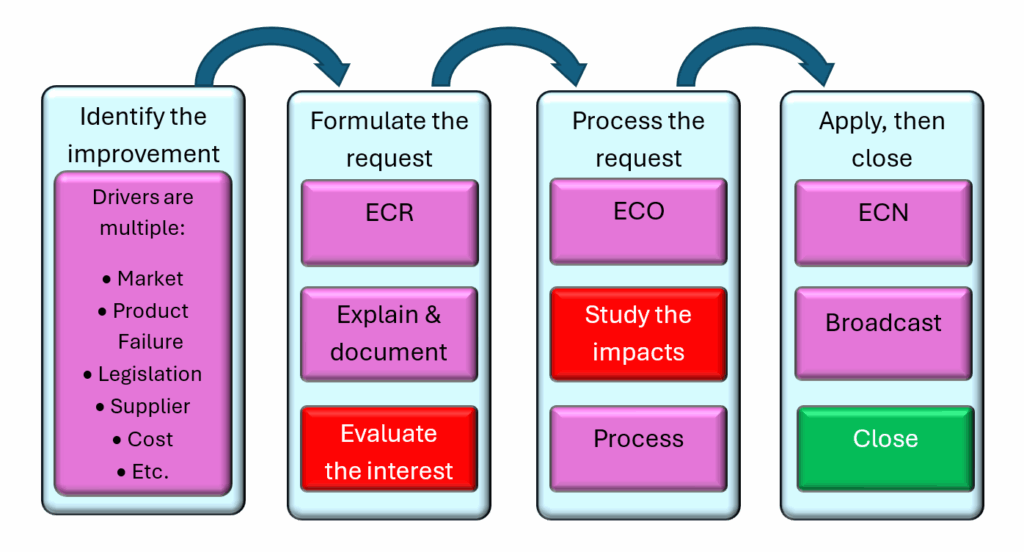
Although often seen as a single process, change actually involves three distinct parts:
Engineering Change Request (ECR): Is the need, or opportunity, for change identified, documented and requested. The request is reviewed, risk assessed and then either approved or rejected.
Engineering Change Order (ECO): Authorises and details the implementation of an approved engineering change. It includes specific instructions on how to execute the change, such as modifications to designs, materials, or processes.
Engineering Change Note (ECN): A communication tool that shares information about updates to a product or process. It tells stakeholders what changed, why the change occurred and how it affects production or quality. It also ensures the team documents, communicates and implements every change effectively.
The changes may be:
Design Changes: Modifications to the product’s design, such as altering dimensions, materials, or components.
Process Changes: Adjustments to the manufacturing process, including changes in equipment, methods, or workflows.
Documentation Changes: Technical Publications, COSH sheets, etc.
What are Common ECM System Problems?
Poor documentation affects traceability and information isn’t easily accessible:
- Why was the change necessary?
-
- Root cause analysis
- Impact analysis
- Risk Analysis (risk of changing Vs not changing)
-
- Who approved it? Or who rejected it and why?
- Which options were considered? and why was the final one selected?
- What other components or products does the change influence?
- What actions were carried out to effect the change?
It’s too difficult to effectively involve all relevant parties to make the best plan, but their input during the approval and processing stages can prevent mistakes and make efficient changes:
-
-
- Those who the changes will affect.
- Those who must take action.
- Functions often only learn about pending changes when they encounter them, because concurrent engineering, even in if applied in NPD, doesn’t cover engineering changes.
-
Teams don’t fully realise the impact of the change, or they struggle with resource-intensive investigations because their impact analysis tools are weak:
- Difficulties performing ‘where used’ (not just to parent parts, but also compliance and safety protocols/standards/certifications)
- Organisation / linking documents generated during impact analysis.
- Estimating true cost of change, or inaction.
- Identifying all required actions.
- Changes to designs or processes are not considered in their full context – Cross-functional review can help reduce this.
Poor Communication / Lack of Transparency:
- No advanced notice of changes to downstream functions.
- Notification of change isn’t always timely or accurate.
- Closed loop process fails
-
- Those who request changes don’t receive updates on progress or rejection.
- Change managers cannot easily see when teams carry out downstream actions.
-
Ensuring that policies and processes are implemented effectively, and that procedures are followed correctly:
- Because they are not understood
- Bypassed for personal convenience.
Compliance problems:
- ISO9001 (JSP940 & 945 for MOD contracts)
- Retaining and demonstrating compliance.
What are the Impacts of These Challenges?
- Implementing changes consumes significant resources, making them expensive and slow, while the need to ‘fight fires’ often overrides opportunities for product or process improvement.
- Poorly considered, or implemented changes create new problems of their own.
- Products reach the market late when teams don’t handle changes for shifting regulatory requirements efficiently.
The Solution
Effective change management reduces the cost of changes, reduces the time required to implement change and allows for better thought-out and implemented changes. It closes the loop with downstream functions, suppliers and customers and creates room for more improvement-related changes alongside those generated by customer requirements, supply chain or regulatory factors – design errors etc.
A controlled process incorporates the following functions; however, in many companies a single person may carry out several of them. Ultimately, the important thing is that the engineering change remains controlled and recorded as each function is completed.
- Issuer: Person behind the request
- Manager: 1st filter, oriented towards the Leader (Moderator)
- Leader: Prepares the work; tracks the progress; broadcasts the ECN when completed. This actor tracks the changes
- Approver: Once the Leader has prepared the change, the Approver launches the implementation. The Leader can also take on this role.
- Executer: Starts the ECO à The Leader is often the person that starts the ECO
- Performer: Designer, Author, etc. carries out the work
These actors receive progress updates and use specific access rights to manage the modification.
So we can view the process like this:
What to Look for in an ECM System
In fact, when we talk about good ECM systems it’s hard not to reference them as part of a PLM system, particularly with its revision control, workflows, templates and also the ability to conduct ‘where used’ searches for referenced documents and parent child references in product structures. The purpose of any PLM system is to ensure the right person sees the right information at the right time.
Therefore, we need a PLM system with:
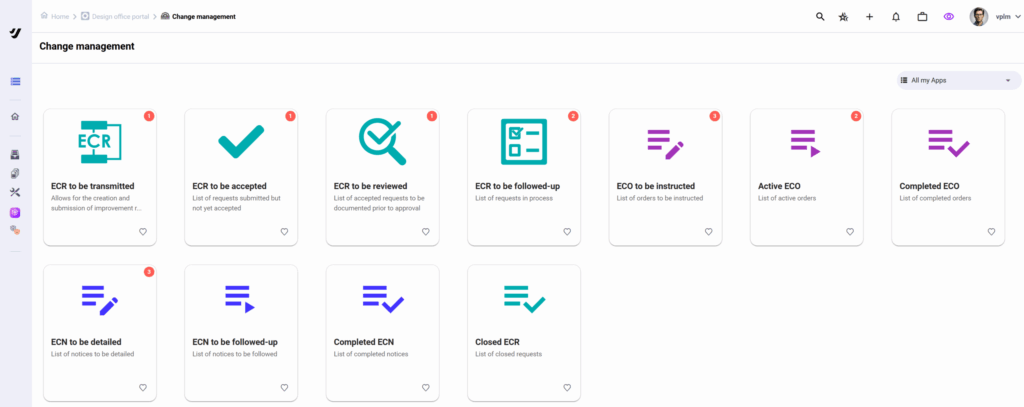
- Central EC management area/panel/dashboard
-
- Single point of entry and enquiry
- Clear demarcation of the different states and actions required
- Clear ‘follow up’ on every change – actions and supporting documents automatically launched as the change moves through the process
- Dashboards – real time reporting, EC status, resource status etc
-
- Transparent demarcation between changes in the ECR, ECO and ECN phases
An example of a central EC management dashboard – image taken from Visiativ PLM Change Management Centre.
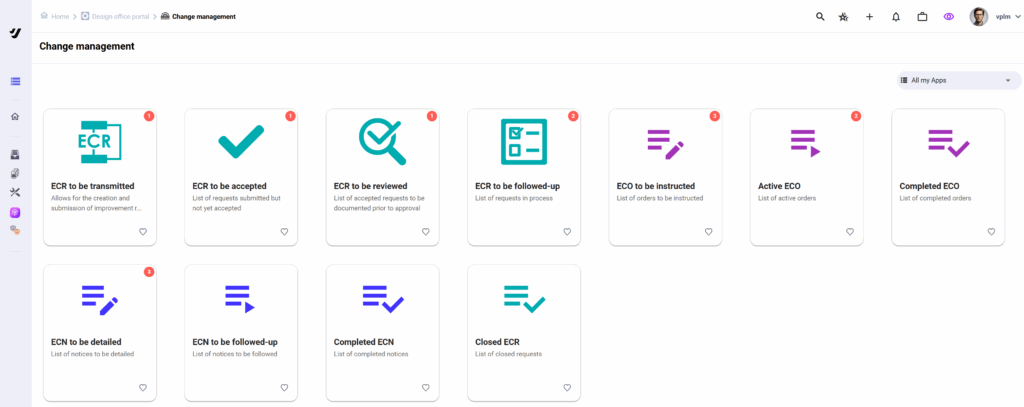
See below to find the relevant information for a completed ECO easily.
In addition, we also want:
- Automated, templated generation of necessary/supporting documents triggered at the necessary points in the process
- Automatic routing of notifications to required departments or individuals
- Effective communication – Email-based notifications.
- Easily demonstrated compliance, for example with ISO9001.
-
- Automatically generated audit trail
- Ease of finding affected and reference documents.
-
- Clear, enforced change management procedures. Automated Workflows – Flexibility (different companies have different change control models)*
- Enhanced and well-recorded impact and risk assessment.
- Metrics;
-
- Cycle time
- Bottlenecks
- Raised / in-process / complete breakdowns (KPIs)
- Suggestion / approval / rejection patterns
-
Get a feel for Engineering Change Management in Visiativ PLM by watching this clip.
How a PLM System Can Help You Manage Engineering Change
PLM powered ECM results in business-level benefits to productivity and governance, such as:
- Productivity is amplified, as the entire enterprise is easily able to participate in the change process.
- Visibility improves, such that critical and ancillary teams and contributors are able to understand, evaluate and respond to the impact of changes on plan.
- Governance strengthens as teams make faster, higher-quality decisions across the business.
- Companies realise value directly by analysing changes more effectively, which reduces scrap and rework.
Contact us to explore the solutions we have available.
*Useful Links
|
|
About the author: This product guide was written by Product Lifecycle Management Consultant, Dave Harrowell. Dave has been implementing PLM and PDM systems since 1998. |
|||
|
|
View Dave Harrowell’s LinkedIn Profile here.
|
|||